

A home battery isn’t automatically a money-saver. If you’re asking “is home battery storage worth it?”, the answer depends on when your household uses electricity, how much solar power you generate and the tariffs available to you. A battery can help you use stored electricity instead of buying it from the grid, but the value varies from home to home.
Conflicting savings and payback claims can be hard to compare. The figures depend on your energy habits, whether you have solar panels and how your import and export rates compare. A system that suits one household may not deliver the same results for another.
This guide explains how to weigh up the options without relying on one-size-fits-all promises. We compare adding a battery alongside new solar panels, retrofitting one to an existing solar system and installing a battery without solar. You’ll also learn what affects savings, how tariffs and battery performance factor in, and which details to gather before deciding. A home-specific assessment can help show whether solar PV and battery storage make sense as a joined-up solution.
Key Takeaways
- Use your electricity habits, solar generation and tariff to answer “is home battery storage worth it” for your household, rather than relying on generic savings claims.
- Separate potential bill savings from other benefits, such as using more of your own solar electricity and having stored power available when you need it.
- Compare adding a battery with new solar, retrofitting one to existing panels and installing storage without solar to see which setup best fits your home.
- Review recent electricity use and solar data, then map when your home imports, exports and uses power across a typical day.
- See how a home-specific assessment can help you understand whether solar PV and battery storage work as a joined-up solution for your household.
Is home battery storage worth it for a UK household?
Home battery storage can be useful, but whether it’s worthwhile depends on your household’s electricity use, solar generation and tariff. A battery stores electricity for use later; it doesn’t generate power. Its financial value mainly comes from using stored electricity instead of buying from the grid. Convenience, resilience and making more use of your own solar generation may also matter, but for different reasons.
A home battery may be worthwhile when you can regularly use the electricity it stores and the value of that use justifies the system’s cost for your household.
That’s why answering “is home battery storage worth it” takes more than a headline savings estimate. Two homes with similar solar panels can get different results if one uses most of its electricity during the day and the other has higher demand in the evening.
What does ‘worth it’ mean for your home?
A battery can reduce the amount of electricity you import from the grid at certain times. That doesn’t mean your total household energy costs will fall by the same amount. Savings depend on when electricity is generated, stored and used, what you pay to import power, and any relevant income from exporting it.
Assess the financial case separately from other benefits. You might value using more of your self-generated electricity or having stored power available, but backup during a power cut depends on the system being designed and configured for that function. Battery storage technology can be used in different ways, as outlined in this Battery storage technology overview.
Which households should look more closely?
Start with homes that regularly generate more solar electricity than they use at the time. If panels produce surplus during the day and household demand rises later, storage may let you use some of that energy in the evening instead of importing as much from the grid. The amount you can use depends on the home’s generation and consumption patterns.
Households on tariffs with different prices at different times may also be able to shift some electricity use to suitable lower-cost periods. The tariff needs to fit your routine, and charging, discharging and exporting arrangements all affect the result. Limited battery use, little solar surplus or equipment that doesn’t suit the existing system can weaken the financial case.
Consider a home where people are in during the day: appliances may use a good share of solar power as it is generated, leaving less surplus to store. In a home that’s empty during the day and busier in the evening, more solar electricity may be available for later use. Neither pattern guarantees savings. The key question is how often stored energy can meet demand that would otherwise be met by grid electricity.
Convenience and resilience are personal considerations, not automatic bill reductions. A battery may make more of your own generated electricity available when you want it, but it won’t remove standing charges or supply electricity it hasn’t stored or received. Treat the financial case and practical benefits as separate parts of the decision, then compare them against your household’s actual usage.
What determines whether a home battery pays its way?
A useful estimate follows the electricity through your home: how much surplus is available to store, how much stored power you later use instead of importing, and whether exporting any remaining surplus brings income. The financial case compares the value of avoided imports and relevant export earnings with the system’s cost and the value of electricity you could have exported rather than stored. Not every unit generated can be captured and used later.
That’s why a single payback figure rarely tells the whole story. To judge whether home battery storage is worth it for your household, an estimate needs to reflect your generation, consumption, tariffs and proposed equipment. Battery size alone doesn’t show how often the system will cycle or how much electricity will meet a useful demand.
How solar generation, household demand and battery size interact
Imagine a home where solar panels produce more electricity than the household needs around midday, while demand rises in the evening as people return and prepare dinner. A battery could store some daytime surplus for later use. If people are home during the day and run appliances while the panels are generating, less surplus may remain to charge it.
A larger capacity doesn’t automatically mean greater value. If the home rarely has enough surplus or evening demand to use the stored electricity, some capacity may go unused. Winter brings shorter days and typically less solar generation than sunnier periods. Heating, lighting and household routines can also change demand. An annual assessment should account for seasonal differences rather than assume a typical summer day repeats all year.
How tariffs and export arrangements affect the calculation
Tariffs change the value of storing, importing or exporting electricity. If your import rate is higher than the payment for exported power, using stored solar electricity at home may be more valuable than exporting that same electricity. A time-of-use tariff can also make charging from the grid during a cheaper period an option. Whether it makes financial sense depends on the price difference, timing and any applicable tariff conditions.
Tariff conditions can change a battery’s value because they affect what you save by avoiding imports and what you give up, or earn, by exporting electricity.
In the UK, the Smart Export Guarantee (SEG) is an export framework through which participating licensed suppliers offer tariffs for electricity exported by eligible small-scale generators. Rates and conditions vary, so check current supplier terms, eligibility requirements and any equipment or tariff pairing conditions rather than relying on an old quoted rate. Compare the overall import cost and export income, not the export payment alone.
A reliable estimate should use recent electricity bills or interval data, solar generation and export records, your current and possible tariff terms, and the proposed battery’s usable capacity, efficiency and expected operating pattern. It should also explain its assumptions about future energy prices and battery performance. For UK safety context, consult the UK Government guidance on domestic battery storage safety.
Solar battery, retrofit or standalone: which situation fits?
The right setup depends on what your home already has and what you want the battery to do. Compare the energy source, system compatibility and likely use before deciding. No single configuration suits every household, so the answer to “is home battery storage worth it” can differ for each of these situations.
| Option | Energy source | Compatibility to consider | Potential use | Key uncertainty |
|---|---|---|---|---|
| New solar with battery | New solar generation, with grid electricity depending on the system and tariff | Panels, inverter and battery can be planned together | Store some solar surplus for use later at home | How much surplus is generated and when the household needs power |
| Battery retrofit | Surplus from an existing solar PV system, and potentially grid electricity | Existing inverter, system design and installation requirements | Store eligible surplus from panels already on the roof | Whether the existing system can work effectively with the battery, and how much surplus is available |
| Standalone battery | Grid electricity, often considered alongside time-of-use tariffs | Battery controls, tariff conditions and household setup | Shift some electricity use between tariff periods; backup may be a separate intended function | Whether the tariff savings and intended use justify the system |
Adding a battery with new solar panels
Planning panels and storage together allows the system design to account for expected generation, household demand and the daytime surplus that might be available to charge the battery. This makes it easier to consider how the components work as a whole, but it doesn’t guarantee a stronger financial return. A home that uses most solar electricity as it is generated may have less surplus to store. The Benefits of home battery storage in the UK also depend on how storage fits with a household’s needs and energy arrangements.
Retrofitting or choosing storage without solar
A retrofit may suit a home that already exports solar electricity, but the existing inverter and system configuration affect what can be added and how it operates. An assessment should account for that equipment rather than treating every solar installation as interchangeable.
Without solar panels, a standalone battery relies on electricity from the grid. Its potential value depends on available tariff periods, charging and usage patterns, and the household’s reason for installing it. Backup power is a distinct use case, not an automatic feature of every battery system. Extract Energy assesses, supplies and installs residential solar PV and battery storage, helping households consider generation and storage together.
Once you’ve identified what your home already has and what you want from storage, a home battery assessment can help bring those factors into a household-specific view.
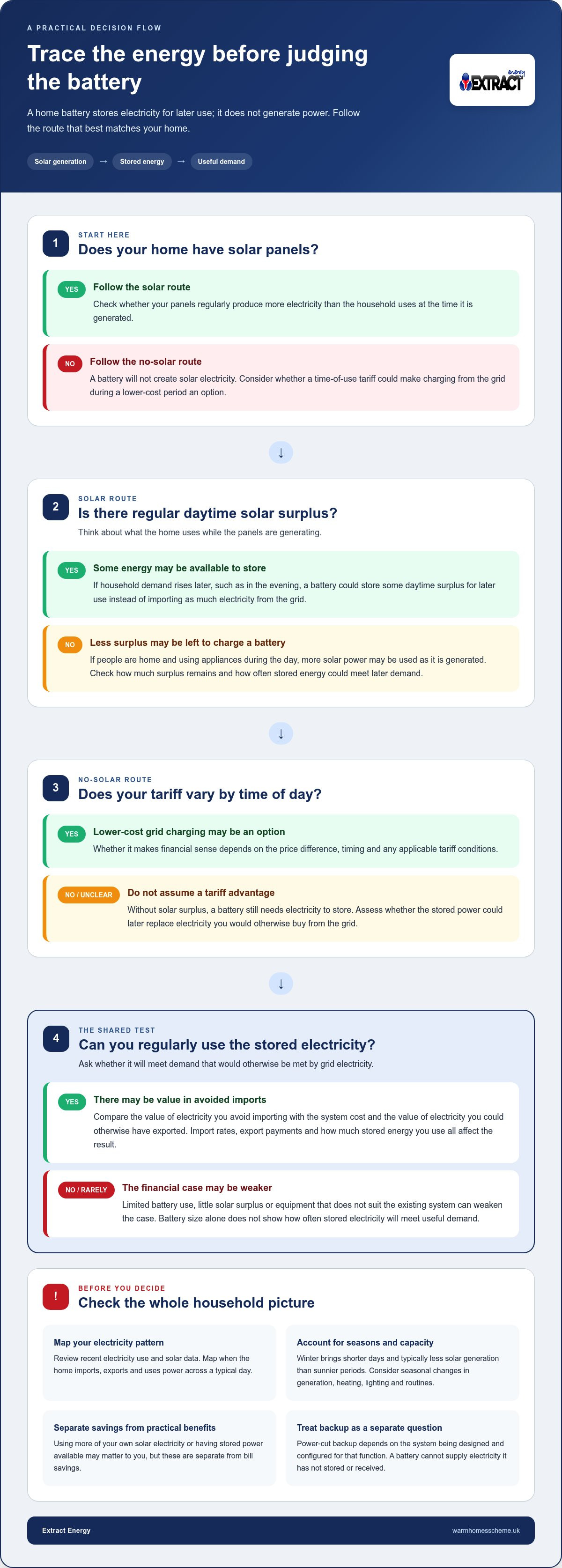
How to assess whether a home battery is worthwhile
A useful assessment starts with your own records, not a standard savings figure. Follow these steps to build a realistic picture of how a battery might fit your home and where the biggest uncertainties remain.
- Gather recent electricity and solar records. Review bills and smart meter data to understand electricity use. If you have solar panels, collect available generation and export records too. Use a representative period where possible, since an unusually sunny or cold spell may not reflect the year.
- Map your energy across a typical day. Note when your home imports electricity, when solar power is generated or exported, and when appliances and other household needs use power. Look for regular daytime surplus and later demand that a battery could serve. Repeat the exercise for different seasons if your usage or solar output changes.
- Write down tariff details. Record your current import rates, export terms, time periods and any conditions that affect when you can charge or export. Check current terms with your supplier rather than relying on an old quote. If you’re considering a time-of-use tariff, compare its lower-cost periods with your actual routine.
- List your existing equipment and intended use. Note your solar inverter and other system details from installation documents. For a proposed battery, use its documented usable capacity and operating specifications, not capacity alone. If backup during a power cut matters to you, state that separately and assess whether the system is designed to provide it.
- Compare realistic alternatives. Estimate how much stored electricity your household could use, rather than assuming the battery will fill and discharge fully every day. Compare that scenario with exporting surplus electricity, using more power while it’s generated, or shifting some use to a suitable tariff period. Include the system’s quoted cost and make assumptions about future tariffs clear.
Battery suitability depends on measured household patterns, not capacity or headline savings alone. Use your records to test more than one scenario, such as a typical day and a lower-generation period. A simple payback calculation can help organise the comparison, but it isn’t a guarantee. Future energy prices, export terms, equipment performance and household routines can change the outcome.
If you’re asking “is home battery storage worth it”, these details give a home-specific assessment a stronger starting point. Extract Energy assesses residential solar PV and battery storage, helping households consider their usage, tariffs and existing system together.
Explore home energy support options alongside your battery assessment to understand what may apply to your circumstances.
How Extract Energy can help you assess home battery storage
Once you’ve reviewed your electricity use, tariff and existing system, a home-specific assessment can help turn that information into a practical decision. It can show how solar generation, household demand and storage might work together, and which assumptions shape the expected benefits. Rather than relying on a generic savings figure, you can consider whether home battery storage is worth it for your home.
What a household-specific assessment should clarify
The assessment should connect your household’s electricity patterns with the solar power available to you. If you already have panels, their generation records and existing equipment help inform how storage could fit into the system. If you’re planning solar, the design can consider generation and battery storage alongside your likely household demand.
It should also make the expected benefits and assumptions clear. For example, how much solar surplus might be available, when you could use stored power, and how your tariff affects the calculation. These are estimates, not promises of a fixed saving. A clear explanation helps you see which parts of the decision are supported by your own information and which depend on future tariffs or changes in your routine.
Plan a practical next step
Before an assessment, gather a few useful details. You don’t need to calculate the answer yourself. The information gives the discussion a grounded starting point:
- Recent electricity bills or smart meter information showing household use.
- Your current import tariff and any export terms, including time periods or conditions.
- Solar generation and export records, if you already have panels.
- Available documents for existing solar equipment, such as inverter details.
- Your main goal, whether that’s using more solar electricity at home, exploring tariff-based charging or considering backup power.
Extract Energy assesses, supplies and installs residential solar PV and battery storage. A joined-up assessment can take account of existing or planned solar equipment and your household’s priorities, helping shape a suitable system rather than treating the battery in isolation. Extract Energy supports households across Hampshire, West Sussex, East Sussex, Surrey, Wiltshire and Berkshire.
If you’re ready to move from general research to a clearer view of your own home, explore a home-specific solar and battery assessment with Extract Energy. Bring the information you’ve gathered and discuss how a tailored system could fit your usage, property and energy goals, without assuming one outcome suits every household.
Take the next step with confidence
Decide what you want a battery to achieve before settling on a system. Your priority might be reducing grid imports, making better use of solar electricity or having storage available for a particular purpose. Keep that goal in view as you consider the figures, and note which assumptions could change, such as your tariff or household routine.
There’s no need to force a yes-or-no answer from a generic payback estimate. Asking “is home battery storage worth it” becomes more useful when you weigh your own energy patterns against the practical benefits you value. If the numbers look uncertain, examine the assumptions closely rather than relying on a promise of fixed savings.
Extract Energy can help you take that next step with a home-specific solar and battery assessment. Explore home solar and battery storage with Extract Energy and move towards a decision that feels clear, considered and right for your household.
Frequently Asked Questions
Can a home battery work during a power cut?
Only if the system is designed and configured to provide backup power. Some batteries stop supplying electricity when the grid goes down, so having a battery doesn’t automatically keep household circuits running. If backup matters, identify which appliances you’d want to power and make sure the system design explains what will remain available during an outage. This is separate from using a battery to manage electricity bills.
Do home batteries need regular maintenance?
Home batteries generally operate automatically, but follow the care and safety instructions for the specific equipment. Keep the area around the unit accessible and clear, and take note of alerts or changes in performance shown by its controls or app. Don’t open the casing or attempt repairs yourself. The product documentation should explain routine checks and what to do if an alert appears.
Are home batteries safe to install indoors?
A battery may be installed indoors only where its instructions and the installation design allow for that location. The room, access, ventilation and surrounding conditions all matter, so don’t choose a spot solely because it looks convenient. For a property in Hampshire or Surrey, for example, the assessment still needs to consider the home’s actual layout and applicable safety requirements, not just the county or property type.
Can I use a home battery to charge an electric car?
A battery may be able to supply electricity to a home circuit that includes an electric vehicle charger, but it won’t necessarily provide a full car charge. Vehicle charging can draw substantial power, so the result depends on the battery’s usable capacity, the charger’s demand and other household loads running at the same time. Include your typical driving and charging routine in the electrical system assessment.
How long does a home battery last?
There isn’t one lifespan that applies to every home battery. Equipment, usage and operating conditions can affect how its capacity changes over time. Before deciding whether home battery storage is worth it for the long term, read the specific warranty for its duration, capacity-retention terms and any throughput limits. These details help you understand what performance the manufacturer covers and what may fall outside the warranty.
Can a home battery be recycled at the end of its life?
Disposal and recycling routes depend on the battery type and product, so don’t put a home battery in ordinary household rubbish or a small-battery collection point. When it reaches the end of its useful life, follow the manufacturer’s disposal instructions and check the appropriate local council or specialist collection arrangements. Confirm the current route before moving the unit, as larger battery systems need specific handling.
