
The boldest savings estimate isn’t necessarily the best reason to choose solar panel installers. A reliable recommendation should make sense for your roof, household electricity use and the way the system will connect to the local grid.
It’s understandable if proposals feel difficult to compare. One may include battery storage, while another may use different assumptions about generation, energy use or export payments. A roof that looks suitable from the street may also need a closer assessment of its orientation, shading, condition and any planning considerations affecting the property.
This guide gives you a practical checklist for checking a solar proposal, comparing equipment and project details, and identifying savings estimates that need clearer assumptions. It also explains how local factors in Hampshire and nearby counties, including property restrictions and grid connection requirements, can affect a system. Extract Energy assesses, supplies and installs residential solar PV and home battery systems across Hampshire, West Sussex, East Sussex, Surrey, Wiltshire and Berkshire. By the end, you’ll know what to look for before moving towards a tailored assessment and how to judge whether a proposed system fits your home.
Key Takeaways
- Start with your household’s electricity use and future plans to identify what a suitable solar system needs to do.
- Compare solar panel installers by the evidence, written scope and customer protections behind their proposals, not just headline savings.
- Use a consistent checklist to compare equipment, installation work, warranties, exclusions and the assumptions behind each estimate.
- Consider how roof orientation, shading, condition and access may affect system design at your property.
- See how Extract Energy brings assessment, supply and installation together across Hampshire and nearby counties, with system design tailored to your home.
Solar panel installers in Hampshire: start with your home and priorities
A solar installation should start with the property and the people who live in it, not a standard package or headline savings figure. Solar panel installers assess the home, design a system around its conditions, supply the equipment and carry out the installation. A useful proposal explains how those steps fit together and why the suggested system suits the roof and household priorities.
A suitable solar system depends on the home, roof and household demand. There’s more to consider than how many panels might fit. Your electricity use, when you’re usually at home and plans such as adding a battery or changing how you use energy can all affect the design. Solar generation varies through the day, so daytime occupancy may influence how much electricity you can use as it is produced.
What should a solar assessment take into account?
A practical assessment considers usable roof space, orientation, shading from trees or nearby buildings, roof condition and installation access. These details help shape the system design and reveal practical constraints early. For example, a roof with limited unshaded space may need a different layout from a broad, clear roof. The right design depends on the property itself, not a general rule based on postcode.
Your household’s electricity use is another important part of the assessment. Reviewing how much energy you use and when you use it helps inform the proposed system size and whether battery storage may suit your priorities. A good recommendation connects those details to what matters to you, such as using more of your own generated electricity or planning for future household changes. For general background on the UK context, see Solar power in the UK.
Is a regional installer the right fit for your area?
Choosing an installer that serves your area can make it more straightforward to arrange an assessment and installation, particularly when comparing options across nearby counties. Extract Energy assesses, supplies and installs residential solar PV and home battery systems in Hampshire, West Sussex, East Sussex, Surrey, Wiltshire and Berkshire.
Regional coverage is useful context, but it doesn’t prove the quality of an assessment or establish what your home needs. Property conditions vary across and within these counties. A Hampshire home with a shaded roof, for instance, may need a different design from a clear-roofed property elsewhere in the region. Look for a proposal that explains how the specific roof, access and household demand shape the recommendation. That’s a sound starting point for judging whether the system fits your circumstances.
Can you trust solar panel installers? Check credentials and evidence
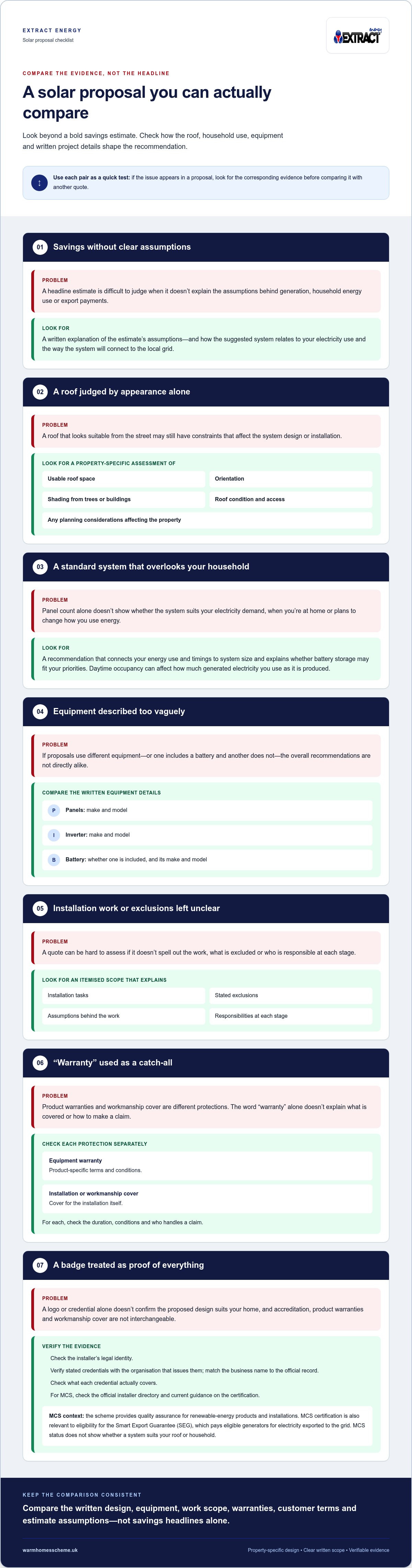
Confidence comes from being able to verify a company’s claims and understand exactly what its proposal covers. Check the installer’s legal identity, verify any relevant credentials with the organisation that issues them, review the written design and scope, then read the contract terms and customer protections before agreeing to the work.
A credential is useful when you verify it directly with the organisation that issues it. Don’t rely on a badge or logo alone. Check that the business name and any stated certification match the official record, and note what the credential covers. Accreditation, product warranties and workmanship cover are separate things, not interchangeable assurances.
What does MCS accreditation tell a homeowner?
The Microgeneration Certification Scheme (MCS) is a quality-assurance scheme for renewable-energy products and installations. For solar, MCS certification is also relevant to eligibility for the Smart Export Guarantee (SEG), which pays eligible generators for electricity exported to the grid. Check the scheme’s official installer directory for current membership, then read its current guidance on what the certification applies to.
MCS status can be a useful checkpoint, but it doesn’t show whether a proposed system suits your roof or household. The design should still explain the equipment, expected generation assumptions and planned work for your particular home.
Which documents make an installation proposal easier to assess?
Review the proposal in writing, with enough detail to understand what’s included. A clear set of documents should show how the recommendation relates to the property and who is responsible at each stage.
- System design: the proposed panel layout and system size, with the property-specific reasons for the recommendation.
- Equipment details: the make and model of the panels, inverter and any battery included.
- Itemised work scope: the installation tasks, along with any stated exclusions or assumptions.
- Warranty information: separate terms for equipment and for installation or workmanship, including who handles a claim.
- Customer terms: the contract, payment arrangements, cancellation information and process for raising concerns.
A panel or inverter warranty relates to the product and its stated terms. Workmanship cover relates to the installation itself. Check the duration, conditions and route for making a claim rather than treating the word “warranty” as a complete explanation.
Extract Energy brings together assessment, supply and installation for residential solar PV and home battery systems. The proposal should explain how the recommended equipment and work fit your home, so you can review the project before deciding how to proceed. If your plans also include wider energy-efficiency improvements, explore whether the Warm Homes grant may be relevant to your circumstances.
Compare solar panel installer quotes on scope, not headline savings
Two proposals can show different totals because they describe different systems or assume different patterns of energy use. Compare what each includes before judging the figures. Savings estimates depend on system design, household energy use and tariff assumptions. If those inputs aren’t clear, it’s difficult to compare estimates fairly.
Solar panel installers should explain how the recommended equipment and work relate to your property. Put the proposals side by side and check the same details in each. A lower headline figure may reflect a smaller system, fewer included tasks or a different battery arrangement, rather than better value for an equivalent installation.
What should a like-for-like solar quote show?
Look for enough detail to establish what’s being supplied and installed. If a proposal is vague, you can’t tell whether it covers the same work as another. Use this checklist to compare the scope, not just the final figure:
- System design: note the proposed panel layout and system size, and whether the design is explained for your roof.
- Equipment: compare the stated panel, inverter and battery models. Check whether a battery is included, optional or excluded, and compare proposals on that basis.
- Installation work: identify what electrical work, connection arrangements and handover tasks are included.
- Access and making good: look for assumptions about access and any work to the roof or property after installation.
- Exclusions and cover: note any electrical upgrades, roof repairs or other work excluded, then compare product warranties and installation cover on their own terms.
For example, don’t compare a quote that includes a battery with a solar-only proposal as if they were the same package. Compare the solar-only scopes first, then consider the battery as a separate part of the overall design. If an item is unclear, get the scope explained in writing before comparing totals.
How should you read estimated savings and export income?
Check the assumptions behind any savings estimate. Does it use your household’s electricity consumption, and does it show how much generated power is expected to be used at home? Consider whether the estimate accounts for when you’re in the property and how your energy use might change. Generation and bill impacts vary with the home, system design and household behaviour, so an estimate based on different assumptions may not reflect your likely experience.
Check the electricity tariff used in the calculation too, including the import rate you pay and any export rate assumed. The Smart Export Guarantee (SEG) provides a route for eligible small-scale generators to receive payments for surplus electricity exported to the grid. Export rates are set by suppliers and can vary, so treat projected export income as an estimate based on stated tariff assumptions, not a fixed return.
Before deciding, make sure each proposal shows its assumptions clearly enough for you to compare them. A transparent estimate helps you understand what could influence the outcome without relying on a promised saving or payback period.
Local solar installation checks for Hampshire and nearby counties
A solar design that suits one property may not suit the next, even on the same street. Roof shape, nearby buildings, trees, access and local constraints all affect what can be installed and how the work is planned. Extract Energy assesses, supplies and installs residential solar PV and home battery systems across Hampshire, West Sussex, East Sussex, Surrey, Wiltshire and Berkshire. The assessment should reflect your area and your individual home.
Could roof condition, shading or access change the design?
Yes. Roof orientation and geometry affect where panels can sit, while trees, chimneys or neighbouring buildings may cast shade at different times of day or year. This can influence the layout and generation estimate. For example, a roof with several small sections may offer a different usable arrangement from a broad, uninterrupted roof, even if both appear to have similar space from the ground.
Roof condition matters too. It should be considered as part of the installation plan, and any signs that the roof needs attention may affect the timing or scope of work. Safe access also shapes how installation can be carried out. A narrow side passage, limited working space or difficult roof access may need to be accounted for in the plan. These factors don’t automatically rule out solar, but their effect should be explained after the home has been assessed.
Which local permissions and grid checks may matter?
Planning considerations depend on the property and its location. A home in a conservation area, a listed building or a property within the New Forest or South Downs National Park may need closer attention to local planning guidance. Don’t assume the same approach applies to every roof or installation. Check the current advice from your local planning authority for the specific property and proposed work.
Grid connection is another project-specific consideration. A Distribution Network Operator (DNO) is the organisation responsible for operating the local electricity network. Its requirements can depend on the system and connection, so check current guidance from the relevant DNO and make sure the proposal explains which connection steps apply and who is responsible for them. Hampshire homes are generally within Scottish and Southern Electricity Networks’ area, but confirm the network operator for your address rather than relying on a county-wide assumption.
Before agreeing to an installation, make sure the assessment has considered roof condition, shading, access, local planning context and the connection route. This turns local knowledge into practical project detail instead of relying on a broad claim that an installer covers your county.
If your plans include wider home energy improvements alongside solar, explore Warm Homes funding options and check the current eligibility guidance for your circumstances.
How Extract Energy takes solar panel installation from assessment to completion
Choosing a solar team should leave you with a clear understanding of what happens next. Extract Energy brings the main parts of the project together: assessing your home, supplying residential solar PV and home battery systems, and completing the installation. The recommendation is shaped by the property and your household’s requirements, rather than a one-size-fits-all system.
What happens during a tailored solar assessment?
An assessment is the starting point for working out how a system could fit your home. It considers relevant site details alongside your energy priorities, giving the proposed equipment and installation scope a clear basis. Roof space, orientation, shading, condition and access can all inform the design. Your household’s electricity use and plans for using energy help shape the discussion about solar PV and whether a battery may be relevant.
The purpose is to connect those details, not simply suggest equipment. A home with changing shade or limited usable roof space may need a different design from one with a clear, uncomplicated roof. Likewise, a household that uses more electricity during daylight may have different priorities from one that wants to store some generated electricity for later use. These factors help guide the design, but they don’t promise a particular generation level or bill reduction.
Once the home and your priorities have been considered, the proposed scope should explain what system is recommended and what the installation involves. Review the design, equipment and assumptions before deciding whether to proceed. Discussing property-specific matters such as access or planning context as part of the project helps clarify practical next steps.
How to take the next step with a local installation team
Extract Energy’s residential solar PV and home battery assessment, supply and installation service covers Hampshire, West Sussex, East Sussex, Surrey, Wiltshire and Berkshire. A few details can give the assessment a practical starting point:
- Your property location and a brief description of the roof, including any known shading or access considerations.
- A general picture of household electricity use, such as whether most consumption happens during the day or in the evening.
- Your priorities, including whether you’re considering solar PV alone or a system that includes battery storage.
You don’t need to settle every design question before taking the first step. The assessment brings the home’s conditions and your requirements into focus, so the proposed system can be considered on its own merits. It also gives you a clearer basis for understanding the suggested scope and the decisions that may follow.
If you’re ready to discuss a system suited to your home, Request a solar assessment.
Make your next step a clearer one
You don’t need to decide every technical detail before exploring solar. Start with what you want the system to do for your household, then use a tailored assessment to turn that priority into a practical plan. This gives you a clear point of reference as you consider whether solar suits your home and what you need to understand before moving ahead.
Extract Energy assesses, supplies and installs residential solar PV and home battery systems across Hampshire, West Sussex, East Sussex, Surrey, Wiltshire and Berkshire. If you’re looking for solar panel installers, a conversation grounded in your property and energy needs is a sensible next step, without relying on a one-size-fits-all recommendation.
Request a solar assessment and begin exploring an option shaped around your home. A clear first step can make the decisions ahead feel more manageable.
Frequently Asked Questions
How long does solar panel installation take?
Installation time depends on the system design, property access and any work needed before fitting. A straightforward roof installation may take less time than a project that needs additional electrical work or a design change. The expected sequence for your home should cover preparation and follow-up steps. Solar panel installers can give a more useful timescale once the project scope and property conditions are understood.
Do solar panels work on cloudy days?
Yes, solar panels can still generate electricity in cloudy conditions, though output is usually lower than in strong direct sunlight. A bright summer day and an overcast winter day won’t produce the same amount. Results also depend on the roof, shading and system design. Treat generation estimates as a guide to performance across changing conditions, not a prediction of the same output every day.
Can solar panels be installed on an east- or west-facing roof?
They may be suitable, depending on the whole property and household. East-facing panels can receive more morning sun, while west-facing panels may capture more later in the day. That timing could matter if your household tends to use electricity at those times. Roof space, shade and condition still matter, so an assessment is more useful than assuming a particular direction will deliver a set level of generation.
Can I add a battery to solar panels later?
In some homes, a battery can be added after solar panels, but compatibility isn’t automatic. The existing inverter, wiring and wider electrical setup can affect the options. For example, an older system may need different equipment or changes to accommodate storage. If you think you may want a battery later, include that priority when considering the initial system design. This can help clarify what a future addition might involve.
Will solar panels power my home during a power cut?
Usually, a standard grid-connected solar system shuts down during a power cut, so don’t assume the panels will keep your household circuits running. Backup power needs equipment and a system configuration designed for that purpose. A battery alone doesn’t automatically provide backup. If keeping selected appliances running is important, make it a specific design requirement and check which circuits the proposed setup would support during an outage.
What happens to electricity my solar panels do not use?
Surplus electricity may be exported to the grid, and eligible households can receive payments through a Smart Export Guarantee tariff. Export rates and terms vary by supplier, so check the current tariff conditions rather than assuming exported electricity earns the same rate you pay to import power. For a Hampshire household, the proposal’s export estimate should state the rate it assumes and how that figure relates to your expected surplus.
