
What if the electricity your roof generates during the day could still help power your home after sunset? That is the idea behind solar panels with battery storage. A battery does not generate electricity, though, and its usefulness depends on how much your panels produce and when your household uses power.
It is reasonable to wonder whether a battery will make a noticeable difference, particularly when solar generation is lower in winter or your home uses most of its electricity during the day. The Warm Homes Plan brings together several forms of support for home upgrades rather than offering one automatic grant to every household. Understanding the technology, as well as the funding, can help you plan realistically.
This guide explains how panels, an inverter and a home battery work together, and how electricity moves between your home, the battery and the grid. You will learn which factors affect whether a battery may suit your household, what seasonal generation means in practice and what to consider when planning a system. Extract Energy supplies and installs residential solar PV and battery systems across Hampshire, West Sussex, East Sussex, Surrey, Wiltshire and Berkshire.
Key Takeaways
- Understand what each part of a solar and battery system does, and how electricity is directed around your home.
- See how household routines and available solar surplus affect whether solar panels with battery storage may suit your home.
- Compare daytime electricity use with evening demand to understand when a home battery may be most useful.
- Identify key planning considerations, including roof suitability, available space and household usage patterns.
- Explore residential solar PV and battery installation from Extract Energy across Hampshire, West Sussex, East Sussex, Surrey, Wiltshire and Berkshire.
What do solar panels with battery storage do for a home?
Solar panels generate electricity from daylight, and a home battery stores some surplus for later use. Together, they can help a household use its own generated electricity when the panels are producing less, such as in the evening. A battery shifts electricity from one time of day to another. It does not generate electricity or guarantee that a home can operate independently of the grid.
Solar self-consumption means using the electricity your solar panels generate in your home, either as it is produced or after storing surplus in a battery for later.
What are the main parts of a solar and battery system?
A home system combines components with different jobs. The panels generate electricity, the inverter converts it into a form household circuits can use, and the battery stores some available surplus. Those circuits carry electricity to appliances and lighting around the home. For a broader overview of how the components fit together, see this guide to a photovoltaic system.
- Solar PV panels: capture daylight and produce electricity.
- Inverter: converts the panels’ direct current (DC) electricity into alternating current (AC), which household circuits use. In a system with a battery, the inverter setup also supports the flow of electricity to and from storage.
- Home battery: stores some surplus electricity for later. Its role is storage, not generation or conversion.
- Household electrical circuits: distribute usable electricity to appliances and lighting, whether it comes directly from solar generation, the battery or the grid.
The inverter and battery are not interchangeable. The inverter manages electrical conversion; the battery stores energy for later. How electricity moves through the system depends on its design and settings.
What does adding a battery change?
Without a battery, solar electricity can power household appliances while the panels are generating. If generation exceeds immediate demand, surplus may be sent to the grid, depending on the system and its settings. This makes the timing of everyday activities relevant: appliances used during generation can consume solar electricity directly.
A battery adds another option. Some surplus can be stored and used when panel output is lower. For example, electricity generated during a bright afternoon could be stored for use later that evening. This can help match the timing of solar generation with household demand, but stored power will not necessarily cover all evening use.
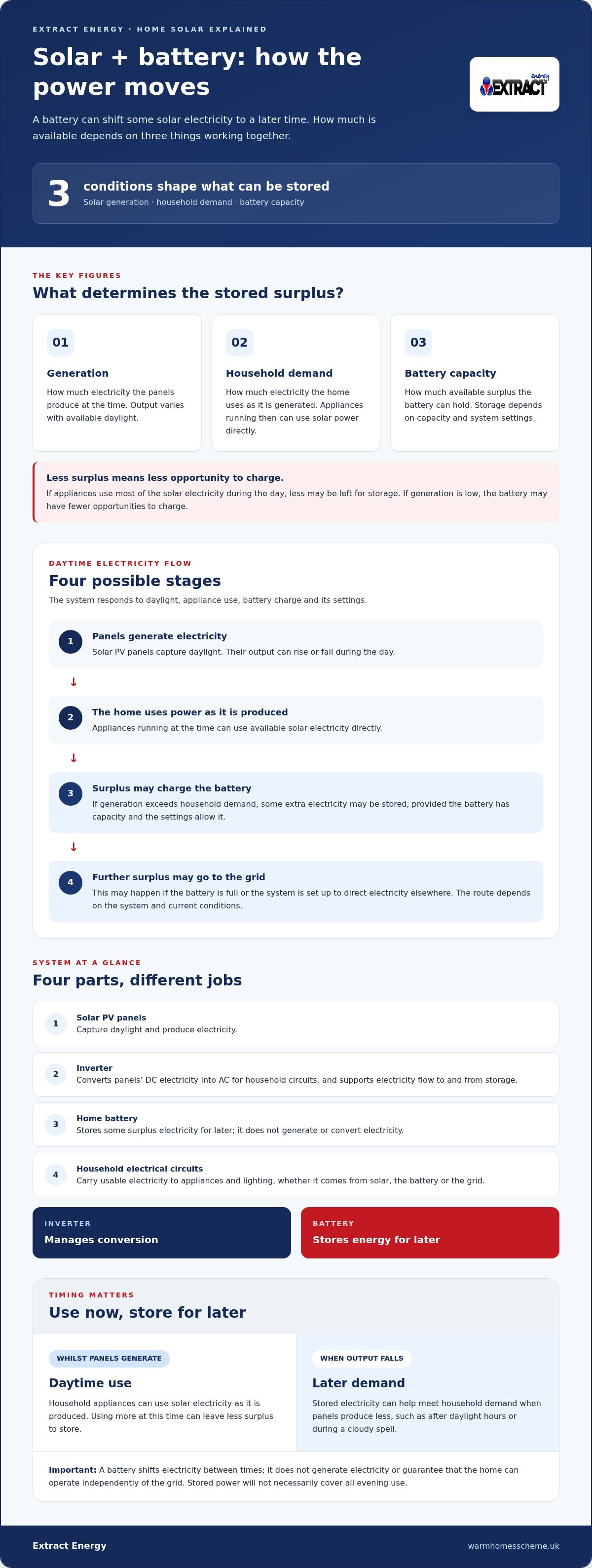
How much electricity can be stored depends on three things working together:
- Generation: how much electricity the panels produce at the time.
- Household demand: how much electricity the home uses as it is generated.
- Battery capacity: how much surplus the battery can hold when it is available.
If appliances use most of the solar electricity during the day, less may be left to store. If generation is low, the battery may have fewer opportunities to charge. A battery can shift some solar electricity to a later time, but its contribution still depends on generation, usage and system design.
How does electricity move between solar panels, a battery and your home?
Electricity does not follow one fixed route. During daylight, your panels generate power while household appliances may be using it. If generation exceeds immediate demand, some surplus may charge the battery, depending on the system settings and available capacity. Later, stored electricity can help meet household demand when the panels produce less.
Generation is electricity produced by the panels, storage is surplus held in the battery, and consumption is electricity used by your household.
What happens to solar electricity during the day?
The system responds to conditions in the home at that moment. Energy flows change as daylight, appliance use and battery charge levels change. Following those flows helps you understand what is being used at home, what may be stored and what may be exported.
- The panels generate electricity. Output varies with available daylight, so it can rise or fall during the day.
- The home uses power as it is produced. Appliances running at the time can use available solar electricity directly.
- Surplus may charge the battery. If generation exceeds household demand, the system may direct some extra electricity to storage, provided the battery has capacity and the settings allow it.
- Further surplus may be exported. If the battery is full, or the system is set up to direct electricity elsewhere, surplus may flow to the grid. The route depends on the system and current conditions.
This is how solar panels with battery storage can change when some generated electricity is used. A battery does not guarantee that every unit will be stored. If appliances draw more power than the panels are generating, the system may also draw electricity from the grid.
When can a home use electricity stored in its battery?
Stored electricity can be used when solar generation falls below household demand, such as after daylight hours or during a cloudy spell. The system can draw on the battery to help supply appliances, subject to its settings. It may not cover all evening or overnight use: the available electricity depends on how much the battery charged and how much the home needs.
Battery capacity sets an upper limit on how much energy it can hold, while its current charge indicates how much is available at a particular time. If daytime demand uses much of the solar generation, less surplus may remain for charging. If the battery has already supplied electricity earlier, its remaining charge may also be limited when demand rises later.
Panel generation, household demand, battery capacity and system settings all affect the balance. Homeowners exploring how energy upgrades relate to government support can read about the Warm Homes Scheme. Support depends on the scheme and household circumstances.
When are solar panels with battery storage a practical fit?
A battery may be most useful when a home has solar electricity left over during the day and needs more power later, after panel generation has fallen. That pattern varies between households. Comparing when you use electricity with when your panels generate it is a practical starting point for judging whether storage may suit your home.
How do household routines affect battery usefulness?
Households with regular daytime demand may use more solar electricity as it is generated, for example when people are at home using appliances. That can leave less surplus for a battery. If more electricity is used in the evening, stored solar power may be more useful, provided there was enough surplus to charge the battery. Neither pattern guarantees a particular result: system design and actual energy use matter too.
| Household pattern | Daytime demand | Evening use | Possible battery fit |
|---|---|---|---|
| People are often at home during the day | More solar electricity may be used as it is generated | May be lower or similar | Less surplus may be available to store |
| Most household members are out during the day | Demand may be lower while panels are generating | May be higher when people return | Stored surplus may help shift some solar use into the evening |
| Demand changes from day to day | Varies with routines and appliance use | Varies too | Suitability depends on the overall pattern and system design |
Use the comparison to think about your own routine, not as a guarantee of lower bills. A battery does not ensure complete energy independence. The outcome depends on generation, household demand, available storage and any electricity drawn from the grid. Consider ordinary weekdays as well as weekends, when people may be home at different times and use appliances differently.
How do UK seasons affect solar generation and storage?
Solar generation changes through the year as daylight hours and weather vary. A battery can store available surplus, but it cannot create electricity when generation is low. With shorter daylight or less favourable weather, there may be fewer opportunities to charge it from solar power. Avoid basing expectations on one bright day or assuming winter demand will always be covered.
For a practical assessment, consider how your electricity use changes at different times of day and between seasons. Then weigh that against roof suitability and a system design that considers panel generation and battery capacity together. The aim is to understand how storage may fit your home, not to assume it will meet every need or remove reliance on grid electricity.
What should you plan before choosing a home solar and battery system?
A useful plan starts with your home, not a one-size-fits-all system. Consider when you use electricity, how much roof space is suitable for panels and where a battery could be positioned. The design should bring these factors together with expected panel generation and battery capacity, so the system reflects your household’s patterns.
Which household details help shape system design?
Start by looking at electricity use across the day. Note when larger appliances typically run, whether someone is usually home during daylight hours and how evening demand compares. This helps show when solar power could be used directly and when stored electricity might be useful. A tailored assessment can consider these patterns alongside the home itself.
- Household use: Consider daytime and evening demand, including regular changes to your routine.
- Roof suitability: Available area, shade and the roof’s condition can all inform panel planning.
- Battery space: The available location and practical requirements of the property help shape how storage fits into the system.
- System balance: Consider panel generation, battery capacity and likely household use together, rather than sizing them in isolation.
This overview can help you prepare to discuss solar panels with battery storage. It also explains why a system designed around one home may not suit another, even if the properties appear similar.
What does the installation journey generally involve?
The process usually starts with understanding the property and household needs, then moves to planning a suitable system, carrying out the installation and explaining how the system works at handover. The details depend on the home and chosen design. This is an overview, not a guide to installation tasks or technical work.
- Assess the home: Review electricity use, roof suitability, available space and practical battery placement.
- Plan the system: Bring expected solar generation, battery capacity and household patterns into one design. Consider how surplus electricity may be used or exported.
- Install and hand over: The system is installed, then the homeowner is shown how to understand its operation and energy flows.
Export arrangements are worth understanding if surplus electricity may go to the grid. Payment options and terms can change, so check current UK guidance before making decisions. For the separate question of whether storage represents value for a particular home, see the discussion titled is home battery storage worth it. Technical installation detail belongs in a dedicated step-by-step guide, while a solar panel installation guide can help with the wider panel process.
If you are considering an upgrade, explore the Warm Homes Scheme alongside your system planning. Any support may depend on your household and property.
Explore solar panels with battery storage from Extract Energy
Choosing a system starts with understanding how your home uses electricity, then considering whether solar generation and battery storage could suit those needs. Extract Energy supplies and installs residential solar PV and home battery systems, bringing the two technologies together as a home energy upgrade.
Your household’s routines, the property and how you want to use generated electricity all matter. A considered plan helps clarify what a system is designed to do, how its main components work together and where stored electricity may fit into your day.
How can a tailored assessment help?
A tailored assessment relates your household’s needs to the practical features of your home. It can consider electricity use at different times, roof suitability, available space and how panel generation and battery capacity may work together. This gives you a clearer basis for discussing system design, without assuming that one arrangement suits every property.
Before exploring options, it may help to build a simple picture of your usual electricity use. Think about when people are at home, when larger appliances tend to run and whether evening demand differs from daytime demand. You do not need to calculate everything yourself; these patterns provide useful context for planning a system around your home and the people who live in it.
What is a sensible next step for local homeowners?
Homeowners can approach the decision in three straightforward stages:
- Understand your energy use: Notice when your household uses electricity and how its routine changes.
- Consider system fit: Take account of the roof, available space, likely solar generation and potential battery use as connected factors.
- Explore a tailored assessment: Discuss how a solar PV and battery system could be planned around your property and household patterns.
Extract Energy serves homeowners across Hampshire, West Sussex, East Sussex, Surrey, Wiltshire and Berkshire. A tailored assessment can help local homeowners move from general questions to a clearer understanding of the options for their property. The aim is to consider the system in context, not to promise a particular level of generation, bill reduction or independence from the grid.
With a clearer picture of your needs, you can make a more informed decision about whether solar panels with battery storage belong in your home energy plans. Explore solar panels and battery storage with Extract Energy to take the next step.
Take the next step at your own pace
Government support can be one part of planning a home energy upgrade, but the right decision starts with what works for your household and property. Use what you have learnt to identify the questions that matter most, including how a system could match your energy use and what you want to understand before choosing an installation.
If you are considering solar panels with battery storage, a tailored assessment can help clarify your options. Extract Energy supplies and installs residential solar PV and home battery systems for homeowners across Hampshire, West Sussex, East Sussex, Surrey, Wiltshire and Berkshire.
Explore solar panels and battery storage with Extract Energy and take an informed next step when you are ready.
Frequently Asked Questions
Can a home battery charge from the National Grid as well as solar panels?
Yes. Some home batteries can charge from the grid as well as from solar panels, depending on the system’s design and settings. This may be useful if a household has a suitable electricity tariff and wants to store power for later. Grid charging does not increase the amount of solar electricity generated. Check how the system manages charging and whether its settings can be matched to your usage.
Will a solar battery keep my home powered during a power cut?
Not necessarily. A standard solar and battery system may switch off during a power cut to protect people working on the electricity network. Backup power requires a system designed to operate safely when the grid is down, and it may supply selected circuits rather than every appliance. If backup matters to you, include it in your system requirements and understand which parts of the home it would support.
Can I add battery storage to solar panels I already have?
Often, a battery can be added to an existing solar PV system, but compatibility and the existing equipment affect how this works. For example, the inverter arrangement may need adapting or replacing, and available space for the battery also matters. Extract Energy supplies and installs residential solar PV and batteries for homeowners in Hampshire, West Sussex, East Sussex, Surrey, Wiltshire and Berkshire. A property assessment can help establish suitable options.
Do solar panels with battery storage need planning permission in the UK?
It depends on the property and where it is in the UK. Planning rules can differ between England, Scotland, Wales and Northern Ireland, and restrictions may apply to certain buildings or locations. Before work begins, check current guidance for your area and whether property-specific restrictions apply. If your home is listed or in a protected area, take particular care to establish the relevant requirements before arranging installation.
How long does a home solar battery last?
There is no single fixed lifespan for every home battery. Longevity can depend on the battery type, how often and deeply it is charged and discharged, operating conditions and maintenance. The manufacturer’s warranty and product information are useful starting points, but a warranty period does not promise that every battery will perform identically throughout that time. Review the expected operating life and warranty terms for the specific system being considered.
Can a home battery export electricity back to the grid?
Some systems can export electricity from a battery, depending on the equipment, its settings and the relevant grid connection arrangements. A battery may store solar electricity for later use, or a system may be configured to export surplus instead. If you are considering payment for exported power, check current Smart Export Guarantee tariffs and supplier terms, as rates and eligibility conditions vary. Do not assume exported battery electricity will automatically earn a payment.
Do I need a smart meter to use solar panels with battery storage?
No. A smart meter is not generally needed simply to generate solar electricity, store surplus in a battery or use that stored power at home. Meter requirements may differ if you want payment for electricity exported to the grid, as these depend on the supplier and tariff. Check the terms of the export arrangement you are considering. A smart meter can also provide more detailed readings of household electricity use.


